Book Review - Torn Letters of Otherness: Absence and Alogos
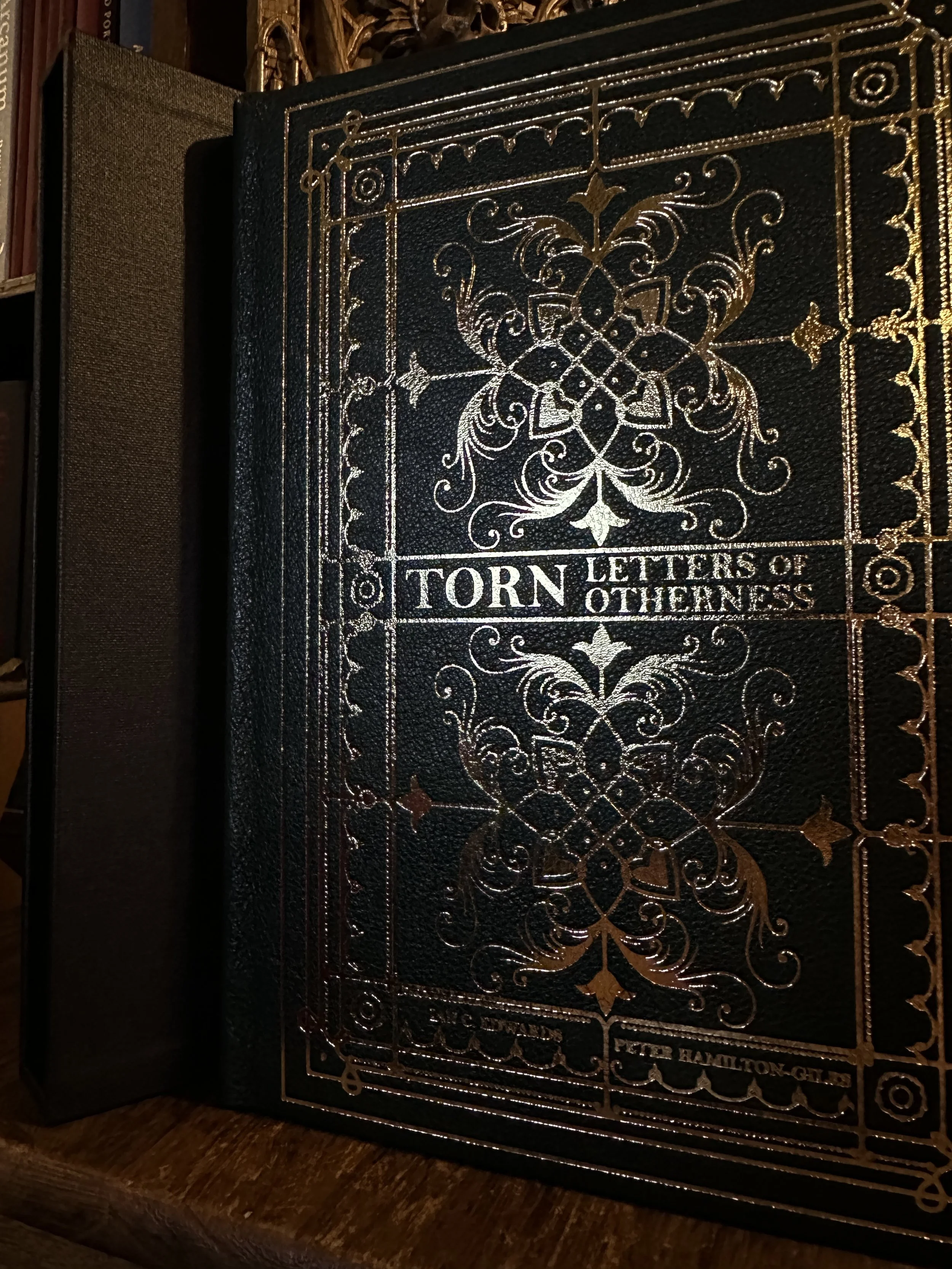
Ian C. Edwards and Peter Hamilton-Giles’s Torn Letters of Otherness: Concerning Absence and Alogos is not a practical manual, not a primer, and not a decorative exercise in occult aesthetics, rather, it is a sustained work of speculative occult philosophy that attempts to rethink what the occult is by way of absence, non-being, tornness, and the limits of language itself. Published by Atramentous Press in a first edition of 2023 and structured through an introduction, a short reflexive hinge, and three substantial movements culminating in “The T(h)orn - An Ontology and Path”, the book presents itself as an exchange of thought between two writers who are plainly trying to force open a new route through contemporary occult discourse, one less interested in stable symbolism or inherited devotional frames than in rupture, paradox, and the difficult work of thinking what remains when familiar forms no longer hold.
What the book is actually about, and this needs stating plainly because the authors themselves often prefer incantatory pressure to straightforward explanation, is the claim that occult experience should not be understood first through visible forms, named deities, or inherited symbolic systems, but through absence, through what is missing, withheld, torn, or encountered as a radical otherness that exceeds ordinary language. Hamilton-Giles, in “Absence and Alogos: A binding of ideation for the metaphysical”, argues that absence is not a mere lack, nor simply an empty negation, but a productive and paradoxical condition that shapes perception, consciousness, and metaphysical apprehension. Edwards, in “Towards a Sabbatic Wissenschaft: From Writing about the Occult to Occult Writing”, pushes this further by treating occult writing as an act of tearing, not merely representing hidden things but rupturing the terms by which they are usually represented. The closing movement, “The T(h)orn - An Ontology and Path”, develops this into an actual spiritual and philosophical path, T(h)ornness, which is defined not by healing, equilibrium, or consolatory return, but by decentring, ungrounding, betrayal of settled belief, and an openness to the void-spaces of being.
This means the book is best read as a manifesto for a particular mode of occult thought, one indebted to phenomenology, dialectics, grammatology, and the post-Spare, post-Grant, post-Sabbatic current of British esoteric speculation, but equally determined to turn against the easy habits of occult discourse. Indeed, one of its clearest and strongest gestures lies in its impatience with tired symbolic repetition. Edwards explicitly argues that many occult signifiers have been so overused that they have become banal, mere echoes rather than dwelling places of being, and this frustration animates the whole text. The authors do not want to repeat the occult as catalogue, system, or museum display, they want to strip it, wound it, and see whether anything living still speaks through the damage. In that respect, the image of the torn letter and the thorn is not decorative language appended after the fact, it is the governing method of the book, both conceptually and stylistically. The reader is not being led through a stable argument in the usual academic sense, but through a deliberate process of abrasion.
That abrasion is both the book’s great strength and one of its most obvious liabilities. On its best pages, Torn Letters of Otherness has the rare quality of sounding as though something is genuinely at stake, not simply intellectually, but existentially and spiritually. Too much writing in the contemporary occult field is either journalistic summary, devotional assertion, or empty performance of obscurity. This book is none of those, at least not primarily. It is serious, and serious in the strongest sense, because it is attempting to think through its own conditions of speech. The recurring concern with logos and alogos, presence and absence, being and non-being, is not merely terminological theatre, it marks a real attempt to ask whether occult philosophy can say anything new without first unmaking the assumptions built into occult language itself. This gives the work an unusual intellectual honesty, even where one may resist its conclusions, because it does not pretend that occult discourse is transparent to itself. It assumes, rightly, that language about the occult is already compromised, already inherited, already burdened by repetition.
There is also, and this should not be understated, a distinct philosophical ambition here that far exceeds the usual horizon of small-press esoteric writing. The invocation of Heraclitus, the repeated engagement with phenomenological questions of perception and presence, the movement toward something the authors call a “Sabbatic Wissenschaft”, all indicate that this is trying to be more than a contribution to niche occult literature. Edwards and Hamilton-Giles are attempting to produce a first philosophy of the occult, or at least a challenge to the assumption that occultism must always borrow its deepest conceptual tools from elsewhere. The proposition that occult practice is a way of being-in-the-world, and that sorcery may be understood as a mode of disclosure rather than simply a technique of effect, gives the book real intellectual scope. Whether every reader will be persuaded is another matter, but the scale of the attempt deserves respect.
It would be a mistake to dismiss the density of the prose as mere indulgence. The style is part of the experiment, and the book says so openly. Edwards states that the letters will not be pieced together for the reader, that understanding cannot be delivered in ready-made form, and that the work is intended to resist ease, even to inflict a kind of discomfort. There is a long modern tradition behind this, one can think of texts which refuse passive reading because they want to alter the reader’s posture, not merely supply information, and Torn Letters of Otherness knowingly enters that territory. The question is not whether the book is difficult, it certainly is, but whether the difficulty is proportionate to the insight it yields. More often than not, I think it is. When the book roots its argument in specific conceptual tensions, such as the distinction between hidden-being and absent-being, or the claim that occult writing should be understood as tearing rather than describing, it is compelling.
One of the more interesting achievements of the volume lies in the dialogue between its two authors. The brief “Reflexive dilemmas and distortions” makes clear that the book is dialogical by design, and this matters because the exchange prevents the text from hardening into a monologue of doctrine. Hamilton-Giles often appears more concerned with the phenomenological and existential pressure of absence, with how consciousness, selfhood, and metaphysical desire are shaped by what cannot be fully rendered, whereas Edwards more readily transforms the discussion into questions of writing, ontology, and occult method. The result is not seamless, but that is to the good. One senses two adjacent but not identical minds pressing against one another, and the friction is productive. This is especially useful in a field where authorial certainty so often goes unchallenged. Here, uncertainty is not an embarrassment to be concealed, but part of the book’s very subject.
The final T(h)orn material is likely to be the most divisive section, but it is also where the book most clearly reveals its destination. T(h)ornness is presented as a path of ungrounding, a refusal of therapeutic spirituality, a movement toward homelessness, hopelessness, imbalance, and radical hospitality toward Otherness. This is not a path for the spiritually comforted, nor for readers who want occultism to confirm the self, stabilise the psyche, or produce neat doctrinal outcomes. It is openly adversarial, openly anti-consolatory, and at times almost anti-religious in the older sense, despite remaining saturated in metaphysical hunger. The insistence that the T(h)orn is not for the many but for the few, and that it functions as a prelude to an occultism of the future, will strike some readers as grandiose, perhaps even wilfully sectarian, yet it also clarifies the book’s deeper refusal. This is a text that does not want to rehabilitate the modern occult mainstream, it wants to wound it into saying something truer.
That refusal, however, creates a real critical problem, because the more fiercely the book positions itself against stale occult discourse, the more it risks producing its own form of orthodoxy, one built from preferred negations rather than inherited affirmations. A rhetoric of exile can become as repetitive as a rhetoric of belonging, and a philosophy of anti-consolation can harden into posture if it is not continually renewed by genuine insight. There are moments here where one can feel that danger approaching. The language of betrayal, despair, headlessness, and void is powerful, but power by itself does not guarantee distinction. The authors are at their best when those motifs are tied to sharp conceptual movement, less so when they become badges of seriousness in their own right. An academic review must say this plainly, because admiration without discrimination is of little use to either writers or readers.
Even so, to stop at those reservations would be ungenerous, and worse, inaccurate. For all its excesses, Torn Letters of Otherness is a consequential book within its field because it is animated by a rare combination of philosophical reach, spiritual risk, and literary self-consciousness. It asks more of the reader than most occult books dare to ask, and it does so not out of simple elitism, but because it believes that occult thought has been weakened by repetition, easy archetypal shorthand, and a reluctance to interrogate the very terms in which it speaks. Whether one agrees with every move is secondary to the fact that the book forces the issue. It insists that absence is not a decorative negative category, but a central problem for occult philosophy, and that language about the hidden must reckon with its own inability to deliver what it names. On this point, the book is not merely interesting, it is important.
Who, then, is this book for, certainly not beginners, and not readers seeking a clear introduction to occultism, ritual, or theory. It belongs instead to that smaller company of readers prepared to sit with conceptual difficulty, especially those already in conversation with the work of Spare, Kenneth Grant, the Cultus Sabbati orbit, and Hamilton-Giles’s own prior draconic and adversarial thought. Yet even within that company, the book should not be valued merely as current-specific writing. Its deeper interest lies in the fact that it tries to treat occultism as a site of rigorous philosophical production, not just as a repertoire of symbols or practices. In that sense it deserves attention beyond its immediate milieu. Academic readers interested in religion, esotericism, phenomenology, and the poetics of metaphysical writing will find much here to wrestle with, provided they are willing to endure a text that would rather provoke than reassure.
In the end, Torn Letters of Otherness is a book of real consequence, not because it resolves the questions it raises, but because it refuses to trivialise them. It is about absence as a metaphysical and occult condition, about the inadequacy of inherited signifiers, about writing as a wound and a method, about the possibility that occult philosophy must begin again from what has been torn, rather than from what has been preserved. It is bracingly intelligent, conceptually ambitious, and undeniably alive. Many books in this area ask to be admired, this one asks to be undergone, and that is a far riskier demand. For readers willing to meet it on its own severe terms, it offers not comfort, not system, and not closure, but something rarer, a serious confrontation with what occult thought might become when it ceases merely to repeat its own emblems and begins, however painfully, to tear through them.